Kyle Poyar's Growth Unhinged surveyed 230 B2B software and AI companies in April and May 2026 about how they price. Four findings stood out to us, and each one turns into an engineering requirement faster than you would expect.
1. Hybrid pricing won, and it depends on caps
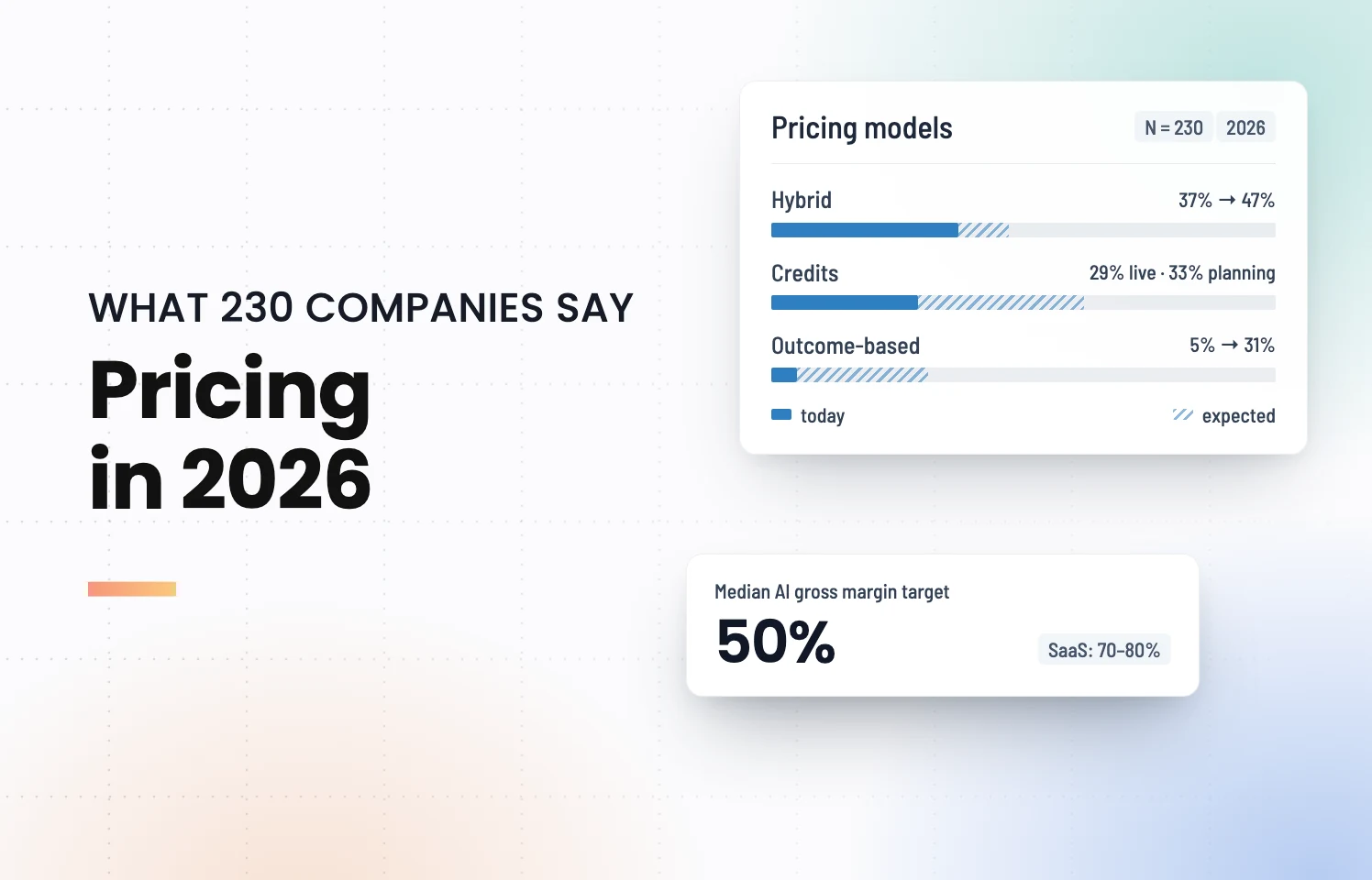
Hybrid is now the most common primary pricing model at 37%, up from 25% a year earlier. Respondents expect 47% within three years. Over the same window the two fixed models, flat fee and per seat, are expected to fall from 42% of the market to 8%.
The interesting part is the reason companies give for liking hybrid. Near the top of the list: capping usage controls cost and reduces the risk of unprofitable customers.
So the most popular pricing model in B2B software works exactly as well as your caps do. If your caps are a report you read after the invoice, you do not have caps. You have a postmortem.
2. AI gross margins are half of SaaS margins
The median target gross margin for AI capabilities is about 50%. For SaaS it has been 70 to 80%. Only 12% of respondents still aim above 80%, and 14% deliberately aim at 20% or lower.
Asked what matters most when pricing AI, 54% named internal costs and margins. That beat competitive positioning at 36% and every value-side factor. The industry talks about value pricing and then prices from cost, because at 50% margins the cost floor sits close enough to the value ceiling that cost binds first.
A twenty point margin drop is not a worse version of SaaS. It is a different business:
| Decision | At 80% margin | At 50% margin |
|---|---|---|
| A 20% discount | costs a quarter of profit | costs 40% of profit |
| A free tier | marketing expense | a real cost line |
| Your heaviest user | basically free to serve | can be individually unprofitable |
| Blended margin | roughly tells the truth | hides the accounts that are losing you money |
That last row is the one that catches teams out. With a long tail where a small share of users drives most of the consumption, your blended number is the average of profitable small accounts and unprofitable large ones. You need cost attribution per customer, not an aggregate.
3. Credits are arriving almost everywhere
29% of companies have AI credits or tokens in their pricing today. Another 33% plan to add them within six to twelve months. Among companies above $50M ARR it is 34% live and 50% planning, so roughly 84% are either shipped or committed.
We wrote in 2024 that credit systems are challenging, and the survey backs that up from the buyer's side. Poyar's own read is that credits are great for vendors and can become a nightmare for customers once a team is tracking different credit models across dozens of vendors. He calls them a lifeline rather than an endgame.
Worth being precise about why a credit turns into a nightmare. There are four reasons, and they are all fixable:
- The customer cannot see the balance.
- The customer cannot predict the burn.
- The customer cannot set their own internal limits.
- The customer does not trust the rate will hold next quarter.
The first three need balances and notifications the customer can actually reach. The fourth needs a credit defined as a stable unit of value, so that when a model ships or a provider changes its prices, the balance still applies and nobody gets repriced retroactively.
4. Outcome-based pricing goes from 5% to 31%
Outcome pricing sits at 5% today. Respondents expect 31% within three years.
We compared usage-based and outcome-based pricing last year and the short version holds: outcome pricing is the strongest message in the market and it moves cost risk onto the vendor. Every failed attempt is margin you already spent, and failures tend to be the expensive ones, because an attempt that fails usually fails after the agent has tried several approaches and called more tools.
Which makes one other number in the survey worth sitting with. Asked for their top two pricing challenges, 30% of outcome-priced companies and 20% of usage-priced companies said customers self-police usage and spend.
Read that again. Their customers deliberately use less than they want to, because they do not trust what the bill will look like.
That reframes limits entirely. A limit the customer can see and set is not just cost control for you. It is what lets them stop throttling themselves.
What the four findings have in common
Hybrid needs caps that hold. Credits need visible balances and customer-settable limits. A 50% margin needs per-customer cost attribution and a ceiling that arrives before the margin floor does. Outcome pricing needs per-attempt cost control.
None of those is an invoicing feature. All of them are decisions that have to be made while a request is being served, which is a different place in your architecture than the system that produces the invoice.
If you are working through this, entitlements and balances, grants and rollovers are the two pieces we would start with.