Every pricing conversation this year opens with some version of "seats are over."
The data half agrees. Seat-based pricing fell from 24% of B2B software companies to 17% in twelve months. Asked where they expect to be in three years, respondents put seats at 1%. When asked which model their investors would prefer, 5% said seat-based, against 35% for hybrid.
The other half of the data is more interesting. Large enterprise vendors are all publicly moving away from seats while continuing to sell an enormous number of them. The usual explanation is inertia. That is partly true and not the useful part.
The useful part is that the seat is still there because it is still doing a job, just not the job it used to do.
What the fixed fee is actually for
Satya Nadella described seats on a Microsoft earnings call as "just entitlement to some consumption," meant to give customers a sense of budget predictability. On the same call he noted that nearly 60% of their service customers already buy usage-based credits.
That is not a defense of per-seat pricing. It is a demotion, stated by the largest seat-based vendor there is.
Read it that way and the apparent contradiction in the numbers resolves. The 17% is not a group of holdouts. It is a fixed component that survived because procurement still needs a number it can plan against, and a page of pure consumption pricing does not give them one.
Why the proxy broke
Per-seat pricing was a proxy for value, and for a long time a decent one. More users meant more usage meant more value, roughly, and because marginal cost was close to zero nobody had to check the chain.
Both ends of that chain snapped:
- An agent does work without occupying a seat.
- One user with an agent can consume more than hundreds of people typing.
- Marginal cost is no longer near zero. Median target gross margin for AI capabilities is around 50%, against 70 to 80% for SaaS.
The survey shows all three failures at once. Among seat-based companies, 36% say they do not have enough expansion revenue, 36% say the model is not future proof, and 30% say it is not aligned with customer value. Those are the worst scores in the table and they are three ways of describing the same break: the number being charged for has stopped tracking the thing being delivered.
Deleting the fixed fee has its own bill
The obvious fix is to stop charging for seats and charge for usage. That trade has a known cost, and the survey prices it: among usage-priced companies, 37% cannot forecast revenue and 30% say their pricing is too expensive for small customers.
Pure consumption pricing works well until a customer's bill goes from $100K one month to $300K the next. No finance team signs that twice.
Which is how hybrid ended up at 37% and heading for 47%. Not because it is elegant. 35% of hybrid companies say their pricing is difficult to explain, which is the worst score in that row. It wins because it is the only shape that gives procurement a forecastable number and still charges for the work.
Demoting a seat, in three steps
If you have a seat-based business and you are adding AI, this is a demotion rather than a migration.
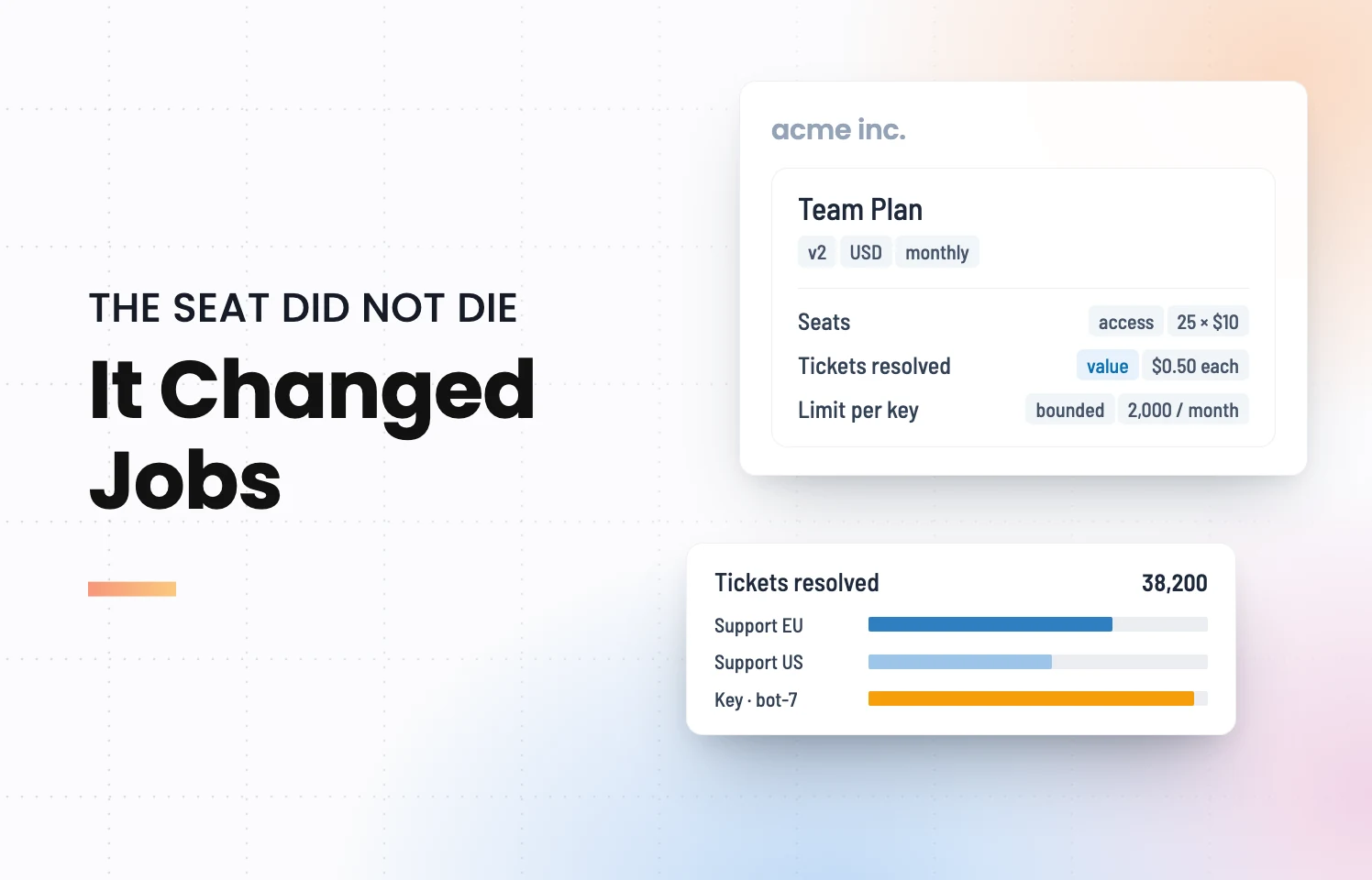
Price the seat as access, not value. Make it cheap enough that nobody optimizes their headcount to avoid it. An account rationing logins is an account not adopting your product.
Move the value story to what gets consumed. Whatever unit the customer already tracks: tickets resolved, documents processed, conversations handled. That is your charge metric now. The seat is not competing with it.
Bound the consumption per identity, not per account. This is the step that makes hybrid work and the one most teams skip. If the fixed fee exists to give procurement predictability, the variable half has to be predictable too. That means limits at the organization, the team and the individual key, so one runaway user cannot drain the balance everybody else is working in.
Get the third step wrong and you have built the worst of both models: a fixed fee that irritates procurement and a variable bill that frightens them.
The thing worth remembering
The seat did not lose because it was a fixed fee. It lost because it claimed to be a value metric and stopped being one.
Keep the fixed component. Then go build the enforcement that makes the variable half safe to sign.
If you are working out where the limits go, entitlements and add-ons are the two mechanics to start with.